What are Microgreens?
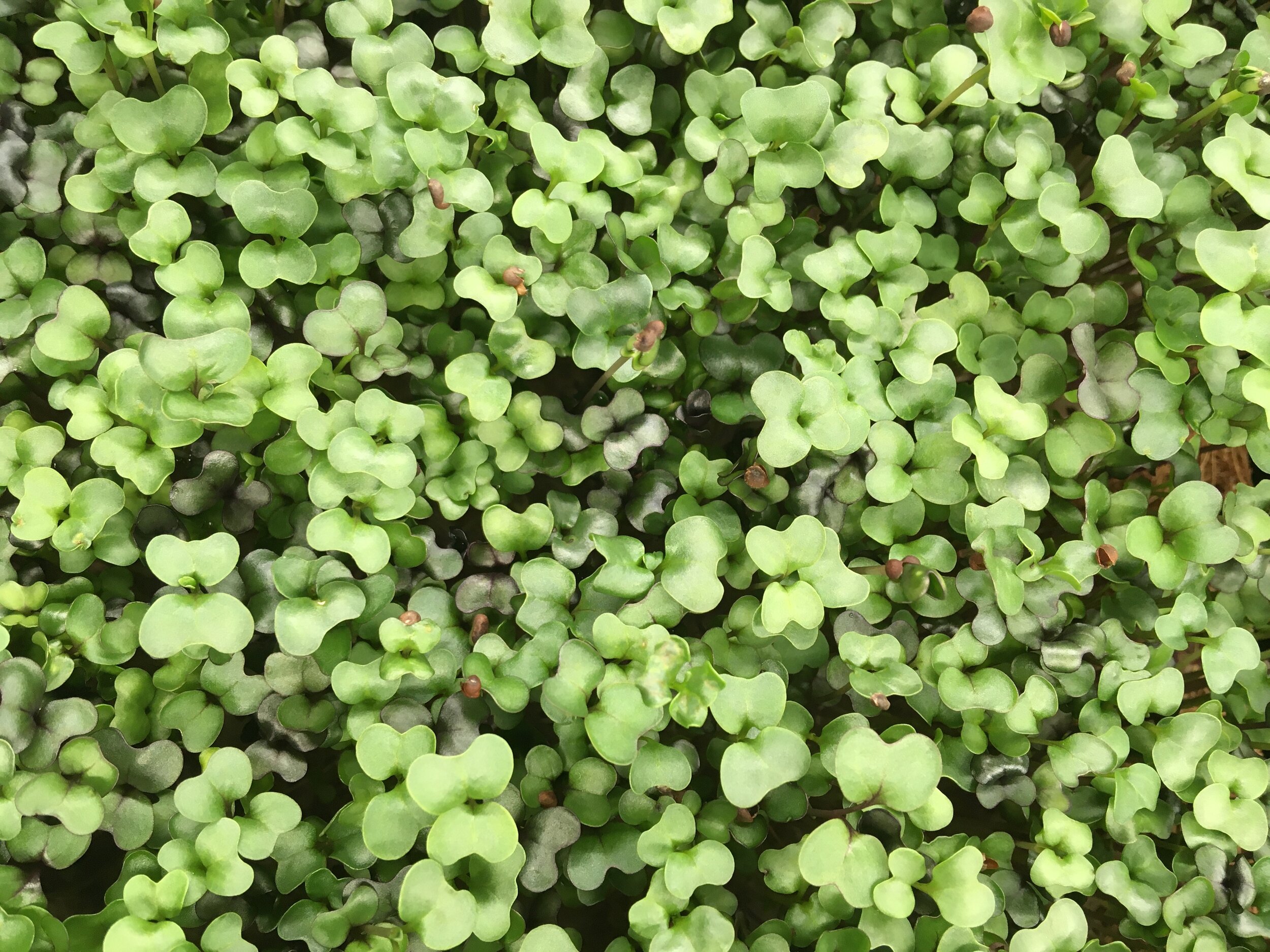
Microgreens are edible cotyledons of vegetables, herbs and flowers harvested within 2 week after planting. You can think of them as infant versions of your average market greens; so think infant kale, infant arugula or broccoli.
Notice I describe them as infant greens and not baby greens which are different. An infant or microgreen is the product of a controlled environment; seed, grow medium, water, air and light.
What makes Microgreens most desirable in my opinion is the amount of nutrients contained in them. All of the nutrients contained in Microgreens have been slowly dispersed throughout the structure of each tiny plant. The smaller the plant body is the the more condensed the nutrients are. As the plants grows the nutrients become less concentrated as they spread throughout the body of the plants. Some farmers grow Microgreens using fertilizers to increase the size of each tiny plant body which will result in a bigger yield. Microgreens do not require fertilizers to produce and provide highly concentrated nutrient levels. This is a gift of Microgreens provided and left from the labor of a dying, seeding mature plant (a natural process of concentrating nutrients). Not unlike an inheritance.
Baby or mature vegetables and herbs require additional nutrients to be added in order to produce the full body of the plants causing more work for the plant and resulting in a diminished nutrient level upon consumption. Most Microgreens offer more nutrition than the fully grown versions of themselves.
Some Microgreens like cilantro, red cabbage and radish can contain up 40 times the amount to nutrients than those found in baby and mature vegetables and herbs.
The experts say…
https://www.healthline.com/nutrition/microgreens#different-types
https://www.webmd.com/diet/news/20120831/tiny-microgreens-packed-nutrients#1
Gov. study on Broccoli Microgreens
https://www.ncbi.nlm.nih.gov/pmc/articles/PMC5362588/